
ARM’s strategic diversification has enabled the company to successfully navigate the downturn in commodity prices during F2024. The company demonstrated resilience by delivering healthy earnings for the year and maintaining a robust financial position, highlighting our ability to thrive in challenging and uncertain market conditions. We are creating sustainable value by prudently investing in our quality businesses and value-enhancing growth projects while paying dividends.
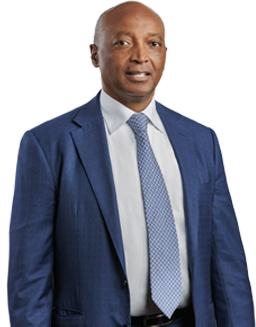
Dr Patrice Motsepe
Executive chairman
Headline earnings for F2024 were 43% lower at R5.1 billion (F2023: R9.0 billion) in a challenging market and operational environment.
Backed by a strong net cash position of R7.2 billion, our strategy is focused on delivering competitive returns to our shareholders and creating sustainable value for all stakeholders by:
We declared total dividends of R15.00 per share for F2024; down 42% from R26.00 per share in the prior year. This represented a 7% dividend yield (as at 30 June 2024) and a payout ratio of 58% of the dividends received from our underlying operations.
Key safety metrics improved for the year, underscoring our commitment to maintaining a safe and healthy workplace for employees and contractors. The group lost-time injury frequency rate (LTIFR) improved to 0.22 per 200 000 man-hours in F2024 (F2023: 0.27), and the total recordable injury frequency rate (TRIFR) improved to 0.50 (F2023: 0.62).
Regrettably, Mr Thomas Ubisse, team leader, was fatally injured in a fall-of-ground accident on 16 June 2024 at Middelpunt Hill shaft, Bokoni Mine. Support and counselling were offered to his family members and all affected employees through the employee assistance programme. We extend our sincere condolences to Mr Ubisse’s family, friends and colleagues.
We continue to experience challenges relating to logistics and water supply, compounded by above-inflation escalations in input costs. Encouragingly, power-supply constraints abated in the second half of F2024.
The management focuses on those factors which are under their control, including; managing and reducing costs, improving productivity and efficiencies through mechanisation and appropriate new technologies.
Unit cash costs remained under pressure in F2024, with above-inflation increases across all operations, except the ARM Coal Goedgevonden Mine and the Participative Coal Business (PCB) operations where costs decreased year on year as a result of increased production and cost-saving initiatives. We proactively manage these costs by taking decisive actions at the loss-making operations within our portfolio.
In F2024, we invested R8.6 billion in attributable capital expenditure across our operations, R4.7 billion of which was expansionary capital.
As part of our short to medium-term plans to optimise and grow our assets:
Subsequent to year end, the construction of a chrome recovery plant at Bokoni Mine was approved by the board.
We also further diversified our portfolio by acquiring 15% of Surge Copper Corporation (Surge), a Canadian company that is advancing projects in copper in a well-developed region of British Columbia, Canada (see page 11).
Surge owns a large, contiguous mineral claim package that contains copper and other metals which are important inputs to the low-carbon energy transition and associated electrification technologies.
Copper is an important commodity and ARM’s medium to long-term objective is to grow and acquire copper assets.
Harmony is currently in a strong financial position, with a net cash balance that places them in a favourable position to pursue their growth ambitions.
ARM’s investment in Harmony was positively revalued by R6 630 million in F2024 (F2023: R2 037 million) as the Harmony share price increased by 112% from R79.25 at 30 June 2023 to R168.05 at 30 June 2024. The Harmony investment is therefore reflected on the ARM statement of financial position at R12 548 million (F2023: R5 918 million) based on its share price.
ARM will continue to consider and evaluate all options relating to its strategic investment in Harmony, with the objective of unlocking and creating value for ARM and its shareholders and stakeholders.
ARM’s strategic investment in Harmony also aligns with ARM’s medium to long-term copper objectives.
Based on information that has been released by Harmony and is in the public domain, at this stage, the ARM board believes it is in ARM’s best interests to retain its equity interest in Harmony.
Harmony’s results for the year ended 30 June 2024 can be found on its website: www.harmony.co.za.
ARM is committed to the goals of the Paris Agreement to limit the global average temperature increase to 2°C, and to reduce it to 1.5°C. We are steadily translating this commitment into concrete plans with measurable targets, as detailed in our climate change and water report on our website.
 |
Refer to page 40 of the climate change and water report for detailed disclosure. |
Additionally, in line with our commitment under the International Council on Mining and Metals (ICMM) sustainable development framework and climate-change principles, our operations apply global good practices in managing scarce natural resources and protecting our environment.
The need for an urgent global response to the threat of climate change is evident from the climate extremes worldwide. We are committed to being part of the solution. In addition to producing metals that are critical to creating a low-carbon future, our broader environmental initiatives concentrate on mitigating the impacts of climate change by reducing carbon emissions as well as using water and energy responsibly and efficiently.
ARM is also making good progress in adopting appropriate new technologies and processes to enhance energy efficiency and reduce our carbon footprint. We are aiming to achieve net-zero greenhouse gas emissions from mining by 2050.
In F2024, we continued to improve decarbonisation pathways detailing the short and medium-term steps to achieve this long-term target. We are continuously working to identify appropriate carbon-reduction initiatives for each operation that are both sustainable and financially responsible.
Last year, we initiated a long-term project with an independent power producer to wheel 100MW of renewable solar photovoltaic (PV) power to our platinum operations. ARM Platinum studies indicate that wheeling this quantum of renewable energy over 20 years could generate approximately 4 900GWh of electricity and save around 4.8mt CO2e in carbon emissions. We expect ARM to make significant savings in electricity costs over the next 20 years. Construction of the solar PV facility is on schedule, with 100MW of power expected to be delivered by August 2025.
In our ARM Ferrous division, a definitive feasibility study is due in December 2024 on the best options for an appropriate energy mix of solar and Eskom-generated electricity at our Northern Cape mines.
In F2024, the ARM workforce consisted of over 23 000 employees and contractors.
We invested R399 million or 8.8% of payroll during the year on skills training across our operations (F2023: R371 million or 9.3% of payroll).
We are committed to inclusivity and diversity and to ensuring that our workforce and management represent all South Africans, as an inclusive and diverse workforce enriches our company and our country. In F2024, 73% of management at all levels was represented by historically disadvantaged South Africans.
Our commitment to improving the living conditions and standards of living of the people residing in the communities neighbouring our operations is a moral and business imperative.
In F2024, our operations invested R189 million in community development projects, particularly those supporting women, youth, historically disadvantaged groups and people living with disabilities. The development projects focussed on:
We also contribute to increasing the pool of entrepreneurial and business-specific skills in our neighbouring communities and supporting the development of local small and medium businesses.
ARM has built good relations with the local community forums, municipalities, government departments and other stakeholders to advance job creation and poverty-alleviation projects.
In addition to creating value for our shareholders, ARM creates sustainable benefits for a range of stakeholders including, local communities, employees, women and youth-owned businesses and black industrialists, in line with the government’s inclusivity and diversity policies.
Despite a particularly challenging environment, mining is still a trillion-rand industry, and its economic contribution remains a key source of revenue for the government. However, constraints in state-supplied electricity, water and transport logistics undermine the potential growth of the mining industry and the South African economy.
In calendar year 2023, the mining industry employed over 479 000 people (up 2.1%), contributed R444 billion or 6.3% directly to gross domestic product (GDP) and exported R781 billion worth of commodities.
The industry paid R190 billion in wages, salaries and benefits to employees who, in turn, support between 2.4 million to 4.8 million dependants. Taxes paid by the South African mining industry included corporate income tax of R86 billion, value-added taxes of R45 billion and mineral royalties of R25 billion.
Following the challenges of 2023, there was encouraging progress in addressing some key constraints for the mining sector in the first half of 2024. The most significant has been the improved provision of electricity, with no loadshedding since the end of March 2024.
On the logistics front, Transnet’s operational performance is stabilising, but much needs to be done to restore peak levels of rail transportation. The outcome of the 29 May 2024 general elections and the resultant formation of the Government of National Unity have been well-received by the domestic business sector, as well as global investors.
The success of the mining industry relies heavily on the efficient provision of electricity, water and logistics infrastructure. ARM and other mining companies operating in South Africa are working with the government and relevant stakeholders to find sustainable solutions that benefit the industry, the fiscus and all stakeholders.
1 Minerals Council South Africa Facts & Figures 2023, published August 2024.
ARM is fortunate to have a world-class management team and board. Our skilled and experienced board is committed to good governance and ethics practices. Our directors make an invaluable contribution to ARM achieving its strategic objectives for the sustainable benefit of our shareholders and stakeholders.
I am grateful to all our directors for their ongoing guidance and commitment to doing what’s in the best interest of the company.
After the 2023 annual general meeting, Mike Arnold stepped down as a non-executive director and we thank him for his contributions over the years.
Thando Mkatshana stepped down as executive director in line with our commitment to reduce the number of executive directors on the board. Thando retains his responsibilities as chief executive of ARM Platinum.
The following changes to the board took place effective from 3 September 2024:
I am grateful to ARM’s CEO, Phillip Tobias and to our world-class management team and all our employees as they are responsible for the successes and profitability of our operations.
We are also grateful for the ongoing support and cooperation of our shareholders, worker representative organisations, our host communities and all other stakeholders.
ARM is committed to working with governments, local communities and employees to create sustainable benefits for its shareholders and all stakeholders.
Dr Patrice Motsepe
Executive chairman
25 October 2024