
André Joubert
Chief executive – ARM Ferrous

World-class safety performance
Robust free cash flow generation
Iron ore contributed 80% to the group segmental EBITDA
Total iron ore production and sales volumes were up 2% and 4% respectively
Average realised export iron ore price up 4%
Total manganese ore production was down 15%
Average high-grade and low-grade manganese ore prices declined by 5% and 1% respectively

ARM Ferrous headline earnings were 9% lower at R5.0 billion (F2023: R5.5 billion), driven by a 90% headline earnings decrease in the manganese division and a 19% increase in the iron ore division.
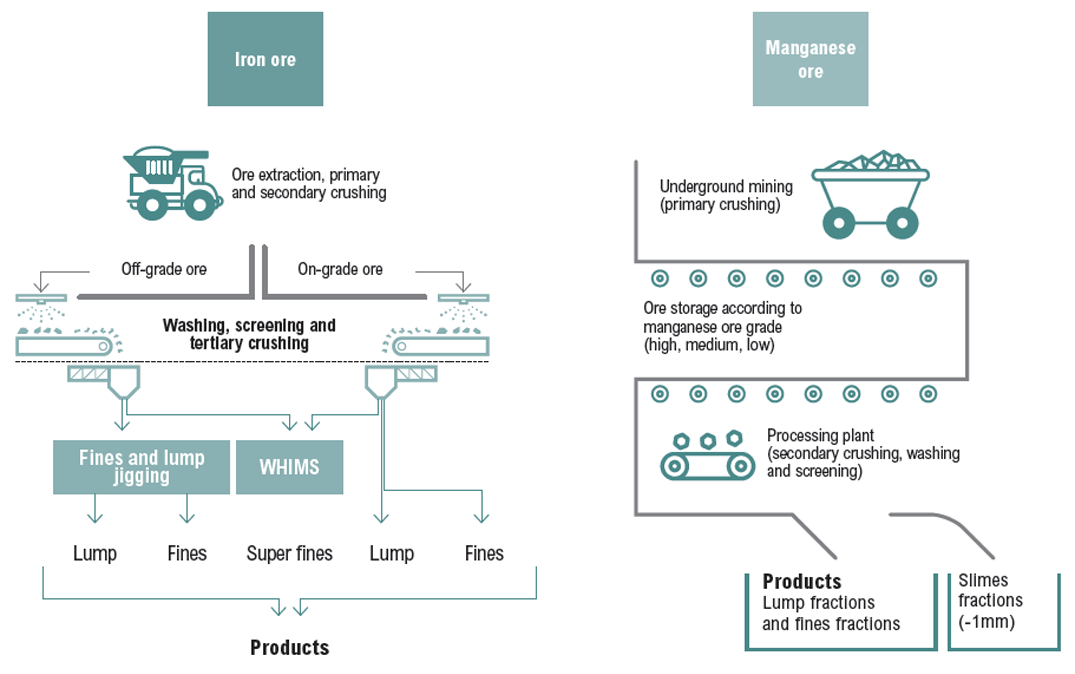
Total iron ore sales volumes increased by 4% to 14.7 million tonnes (F2023: 14.2 million tonnes). Export sales volumes were 2% higher at 12.2 million tonnes (F2023: 12.0 million tonnes).
Local sales volumes increased 11% to 2.5 million tonnes (F2023: 2.2 million tonnes), driven by higher offtake from a local customer.
The lump-to-fines ratio increased from 56:44 in F2023 to 57:43 in F2024.
Total iron ore production volumes increased by 2% to 14.1 million tonnes (F2023: 13.9 million tonnes). F2023 production volumes were lower due to logistical challenges and full stockpiles as previously reported.
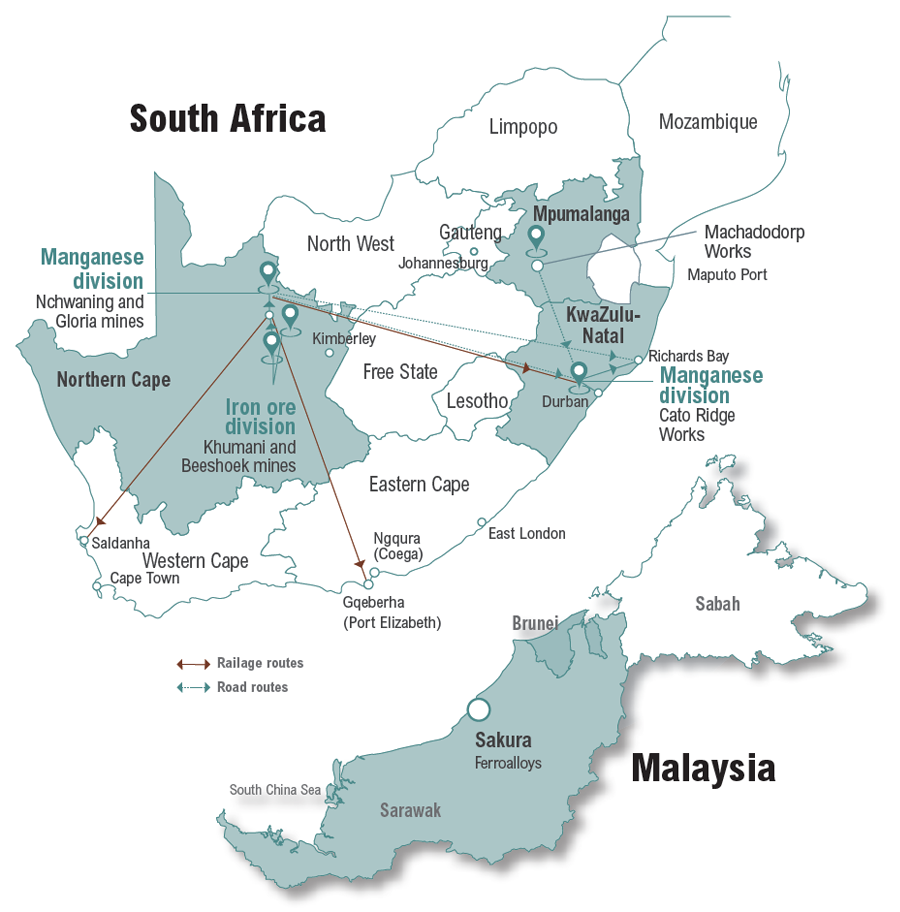
Water supply to the Northern Cape mines remains a risk. The supplemental supply of water from a neighbouring mine’s stormwater was depleted in May 2023. This, together with the inability to get sufficient water from the Vaal Central Water Board (VCWB), impacted Khumani Mine. Management supplemented Khumani’s water requirement from on-mine boreholes and made more sustainable arrangements with the neighbouring mine. Since January 2024, Khumani has had no production losses due to water shortages. This arrangement is working well but is not sustainable. The long-term solution is the urgent start of phase 2 of refurbishing the Vaal Gamagara pipeline, which is being addressed as a key priority between the Department of Water and Sanitation and the Northern Cape mines.
On-mine production unit costs for the iron ore division increased by 10% to R400 per tonne (F2023: R364 per tonne). This was mainly due to inflation-related cost escalations and a higher increase in cash costs combined with more waste-stripping tonnes expensed and less waste-stripping tonnes capitalised.
Unit cash costs per tonne for the division rose 5% to R507 per tonne (F2023: R482 per tonne) due to inflation, higher mining expenses due to higher stripping ratio and higher plant expenses. This was partially offset by higher production volumes and lower diesel and explosive prices.
On-mine unit production costs at Khumani Mine increased 11% to R383 per tonne (F2023: R344 per tonne) while on-mine unit cash costs (which exclude run-of-mine ore stock movements and include capitalised waste-stripping costs and certain non-cash adjustments) were 6% higher at R485 per tonne (F2023: R455 per tonne). The increase was mainly due to inflation-related cost escalations, higher stripping ratio and lower capital waste tonnes, partially offset by higher production volumes and lower diesel and explosive prices.
On-mine unit production costs at Beeshoek Mine increased by 5% mainly due to inflation, lower mining cash cost and a lower work-in-progress adjustment due to lower dumps level.
Beeshoek Mine’s unit cash costs were in line with the prior year. Inflationary increases on cost were offset by a 3% increase in production volumes and lower diesel and explosives prices.
Unit cost of sales for the iron ore division, which includes marketing and distribution costs, were 7% higher, mainly due to higher on-mine production costs (discussed above) and increased railage costs. Sales and marketing costs, which are determined based on free-on-board revenue, were higher owing to higher US dollar iron ore prices in F2024.
Manganese ore sales volumes in F2024 increased 2% to 4.4 million tonnes (F2023: 4.3 million tonnes). Export sales volumes rose 3% to 3.7 million tonnes (F2023: 3.6 million tonnes), due to the rollover of shipments from F2023 and local sales volumes that were higher at 0.75 million tonnes (F2023: 0.73 million tonnes).
Production volumes at Black Rock Mine decreased 15% to 3.6 million tonnes (F2023: 4.3 million tonnes) due to operational challenges at Nchwaning 3, exacerbated by a decision to stop producing unprofitable ore, in turn affecting the development and opening of new, more profitable mining areas. The recovery plan was successfully executed but resulted in production delays until the end of March 2024. Ramp up to the required full production run-rate was only achieved in June 2024.
On-mine unit production costs at Black Rock Mine rose to R857 per tonne from R732 in F2023. On-mine unit cash costs increased to R879 per tonne in F2024 due to inflation and lower production volumes, with an adverse effect on fixed-cost dilution and increase in power costs.
Unit costs of sales (which include marketing and distribution costs) increased 6% due to higher production costs (as discussed above) and the increase in inland logistics costs, offset by lower marketing expenses driven by lower manganese ore prices and lower freight rates.
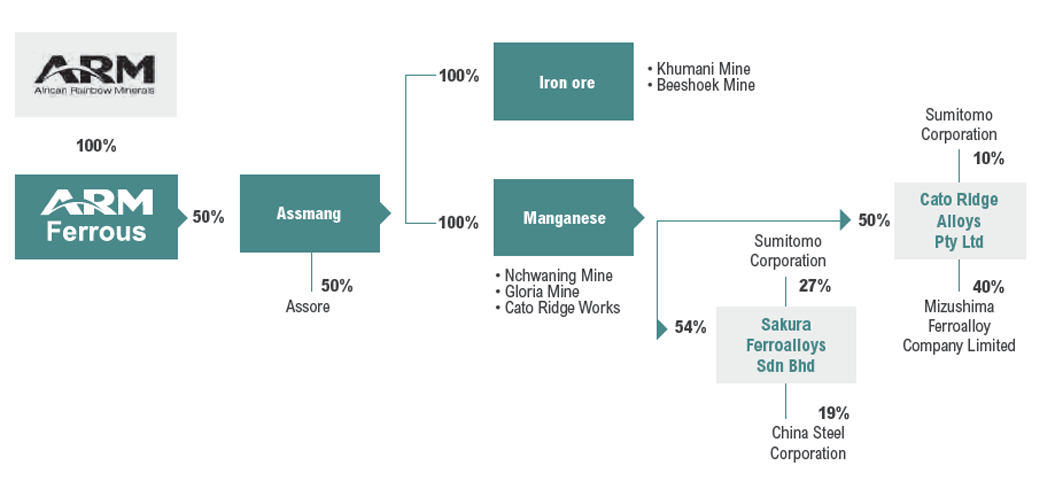
High-carbon ferromanganese production at Sakura (100% basis) decreased to 230 000 tonnes (F2023: 253 000 tonnes). High-carbon ferromanganese sales (100% basis) declined 5% to 226 000 tonnes (F2023: 237 000 tonnes). Lower production and sales volumes in F2024 reflect decreased demand.
High-carbon ferromanganese production at Cato Ridge Works decreased by 13% to 101 000 tonnes (F2023: 116 000 tonnes), mainly due to holding back production because of soft market demand in F2024.
For the same reason, medium-carbon ferromanganese production at Cato Ridge Alloys (100% basis) declined 10% to 51 000 tonnes (F2023: 56 000 tonnes).
High-carbon ferromanganese sales at Cato Ridge Works decreased 28% to 31 000 tonnes (F2023: 43 000 tonnes), impacted by lower production and a decrease in demand. Medium-carbon ferromanganese sales at Cato Ridge Alloys (100% basis) decreased by 8% to 50 000 tonnes (F2023: 54 000 tonnes), impacted by lower market demand in F2024.
Unit cash costs at Sakura decreased 12% in F2024. The significant drop is mainly due to a 23% decrease in ore prices and 25% decrease in reductant prices, offset by lower production volumes and inflationary increases in other conversion costs.
Unit cash costs at Cato Ridge Works rose 11% in F2024. The significant increase is mainly due to a 13% reduction in production volumes, above-inflation increases in power costs and the cost of ore from Black Rock, plus inflationary increases in other raw material prices.
Medium-carbon ferromanganese unit cash costs at Cato Ridge Alloys decreased 1% in F2024.