ARM delivered strong financial and operational results, underscoring the strength, resilience and inherent value of its diversified portfolio.
We achieved a significant safety milestone of zero fatalities, our first fatality-free year since F2017. Given our robust financial position, we are investing in our existing businesses and in value-enhancing growth projects, while committing to continue paying competitive dividends.
Headline earnings for F2026 increased by 19% to R3.2 billion (F2025: R2.7 billion) mainly due to higher US dollar PGM basket prices, despite a challenging operational and volatile commodity environment.
Backed by a strong net cash position of R10.2 billion, ARM remains focused on delivering competitive returns to our shareholders and creating sustainable value for all stakeholders.
A significant strategic milestone was the board's approval of the Bokoni 180 000 tonnes per month (ktpm) development project and the resumption of open-pit mining and nickel concentrate production at Nkomati Mine, both of which represent important steps in advancing ARM's growth strategy (detailed here).
We declared total dividends of R12.00 per share for F2026, up from R10.50 per share in the prior year. This represents a 7% dividend yield as at 30 June 2026 and a payout ratio of 64% of dividends received from our underlying operations.
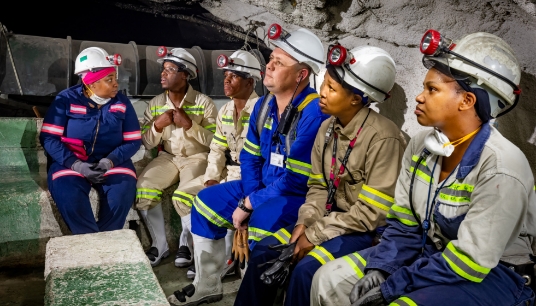
Key safety metrics improved in F2026, as detailed in the chief executive officer's statement. Importantly as stated previously, ARM recorded zero fatalities, a landmark safety achievement, and the first fatality-free year since F2017.
This achievement is a testament to the numerous coordinated initiatives undertaken to embed safety as a shared responsibility across the organisation and to entrench it within our culture. It further reinforces our deep commitment to providing a safe and healthy working environment for all employees and contractors.
In F2026, we invested R5.0 billion in attributable capital expenditure across our operations. As part of our short-to long-term plans to optimise and grow our assets:
Our disciplined approach to capital allocation reflects our commitment to delivering globally competitive returns to our shareholders and benefiting all stakeholders.
ARM's strategic investment in Harmony provides meaningful diversification through exposure to gold, as well as indirect exposure to copper through Harmony's growing copper portfolio.
This investment supports ARM's medium- to long-term commodity diversification objectives and contributes to shareholder value through dividend income and participation in Harmony's growth. ARM will continue to evaluate all options relating to its strategic investment in Harmony, with the objective of unlocking and creating value for ARM and its shareholders.
Harmony remains in a strong financial position. This positions Harmony to generate cash, deliver growth and create enduring value through the commodity cycles.
ARM's investment in Harmony was positively revalued by R388 million in F2026 (F2025: R5.7 billion) as the Harmony share price increased by 2% from R244.81 at 30 June 2025 to R250.00 at 30 June 2026. The Harmony investment is, therefore, reflected on the ARM statement of financial position at R18.7 billion (F2025: R18.3 billion) based on Harmony's share price.
We remain fully committed to Harmony as a strategic investment and are confident in the ability of its management to drive growth and value for its shareholders.
Harmony's results for the year ended 30 June 2026 can be found on its website: www.harmony.co.za.
Underpinned by our strategic objectives and corporate values, we recognise our responsibility to manage and mitigate the potential negative impact of our activities on the natural environment.
ARM met its short-term target of a 15% absolute reduction in scope 1 and 2 emissions by F2026 against an adjusted F2023 baseline. Emissions inside the adjusted target boundary were 16% below the baseline.
We made meaningful progress on our renewable energy ambitions during the F2026 financial year. Following the completion of the 100MW solar plant, our PGM operations began receiving up to 50MW of renewable power in December 2025. The full 100MW was delivered subsequent to year end.
The long-term power purchase agreement in place is expected to deliver substantial environmental and financial benefits, including an estimated 30% reduction in ARM Platinum's carbon dioxide (CO2) emissions and total savings of around 4.8 million tonnes of CO2 equivalents over the 20-year term.
In line with our goal of net-zero greenhouse gas emissions from mining by 2050, we are making steady progress on identified decarbonisation pathways. This progress also forms part of the performance conditions in our long-term incentive plans for executive and senior management.
Download ARM CCWRefer to the 2026 climate change and water report for detailed disclosure.
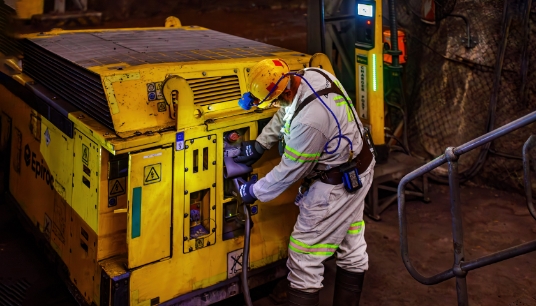
In line with our commitment under the International Council on Mining and Metals (ICMM) sustainable development framework and climate-change principles, our operations apply global good practices in managing scarce natural resources and protecting our environment. As a member of the ICMM, we are equally committed to operating our tailings storage facilities in line with global best practices set out by GISTM and company policies.
In terms of broader initiatives, we continue to support the goals of the Paris Agreement to limit the global average temperature increase to 2°C, and to reduce it to 1.5°C. We are incrementally translating our commitment into concrete plans and measurable targets.
We play a role in the urgent global response to the threat of climate change, now evident in weather extremes worldwide. While we produce metals that are critical to creating a low-carbon future, our broader environmental initiatives focus on mitigating the impacts of climate change by reducing carbon emissions while using water and energy responsibly and efficiently.
With over 20 000 employees and contractors across our operations, the group is a significant employer in South Africa.
To attract, develop and retain talent, we offer competitive total compensation and invest in developing the skills, capabilities and leadership potential of our people. In F2026, we invested R379 million or 8.2% of payroll (well above stipulated levels in the mining charter) on skills training across our operations.
We are committed to diversity, equity, meritocracy and inclusivity, ensuring that our workforce and management represent all South Africans, as an inclusive and diverse workforce enriches our company and our country. In F2026, 73% of management at all levels was represented by historically disadvantaged South Africans.
Download ARM ESGRefer to the 2026 ESG report for detailed disclosure.
Improving the living conditions and standards of living of people in the communities neighbouring our operations is a business and moral imperative.
In F2026, our operations invested R109 million in community development projects, particularly those supporting women, youth, historically disadvantaged groups and people living with disabilities. These development projects focused on providing water and sanitation, key community infrastructure, health and education.
Importantly, we also contribute to providing skills and expertise to our employees from the host communities, as well as increasing the pool of entrepreneurial and business-specific skills which supports the development of local, small and medium businesses.
ARM maintains good relations with community forums, municipalities, local, provincial and national government departments and other stakeholders, to advance job creation and poverty-alleviation projects.
In addition to creating value for our shareholders, we create opportunities and sustainable benefits for a range of stakeholders, including local communities, employees, women and youth-owned businesses and black industrialists, in line with the government's inclusivity and diversity policies.
Download ARM ESGRefer to the 2026 ESG report for detailed disclosure.
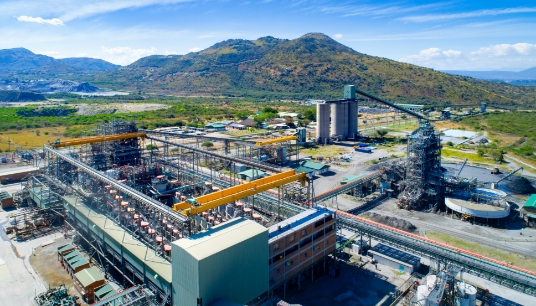
In South Africa, mining is a R1 trillion industry, which remains a key contributor to the South African economy and a significant source of government revenue.
The country's new critical minerals and metals strategy classifies platinum, iron ore and manganese as high-criticality minerals that enable global energy-transition technologies.
ARM mines and beneficiates a portfolio of commodities that serve as critical inputs into steel, transportation, electrical transmission and energy storage systems that underpin global decarbonisation, electrification and sustainable infrastructure development.
The latest data shows that the mining industry contributed R439 billion or 5.8% directly to gross domestic product (GDP) and exported R814 billion in primary minerals. Taxes paid include company tax of R31 billion, value added taxes of R22 billion, and mineral royalties of around R11 billion.
The industry paid R200 billion in wages and salaries to around 470 000 employees, supporting the livelihood of nearly 1.9 million people (assuming an average household of four people). Including the 400 000 people employed by direct suppliers of goods and services to the mining industry, the total direct formal employment impact is about 870 000 people, supporting at least 3.5 million people.
A key development in 2026 was the inclusion of mining as one of the key growth drivers in phase 3 of the government business partnership to accelerate GDP growth and create jobs. Since 2023, this partnership has been instrumental in addressing constraints to economic growth, particularly in energy, logistics and water infrastructure. The national power grid is now considered stable and rail performance is recovering slowly. It is imperative that we address the significant challenges in water infrastructure to fully restore the fundamental services needed for a thriving economy that attracts sustainable, long-term capital investment.
ARM and other mining companies in South Africa continue to work with the government and relevant stakeholders to find sustainable solutions that benefit the industry, the fiscus and all stakeholders.
| 1 | Minerals Council South Africa 2025 facts and figures handbook, updated February 2026. |
We remain steadfast in our commitment to global best practices relating to governance, transparency, ethics and good business practices.
ARM has a world-class management team and board. Their contribution is invaluable in helping ARM achieve its strategic objectives of delivering competitive returns for its shareholders and creating sustainable value for all stakeholders.
I thank the management team and the board for their ongoing guidance, advice and commitment to advancing the best interests of the company.
Dr Tshifhiwa Ramuthaga and Mr Peter Steenkamp were elected as independent non-executive directors at the annual general meeting on 5 December 2025. Dr Rejoice Simelane and Mr Joaquim Chissano stepped down as directors at that meeting, and we thank them for their contributions over the years.
To ensure compliance with the amended JSE Listings Requirements, I retired as executive chairman and employee of ARM on 15 February 2026. I remain a director of the company, serving as non-executive chairman of the board from 16 February 2026.
On behalf of the board, we thank ARM’s CEO, Phillip Tobias, our outstanding management team and all our employees. You are responsible for the success and profitability of our operations.
We also deeply appreciate the ongoing support and cooperation of our shareholders, worker representative organisations, host communities and all other stakeholders.
I continue to believe in the global competitiveness of ARM and the potential of the mining industry to create good returns for its shareholders.
We are committed to working together with local and provincial governments, as well as the national government, local communities and our employees for the benefit of all stakeholders.
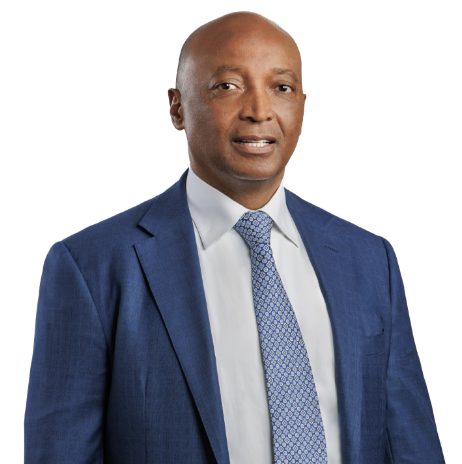
DR PATRICE MOTSEPE
Founder and chairman
19 October 2026